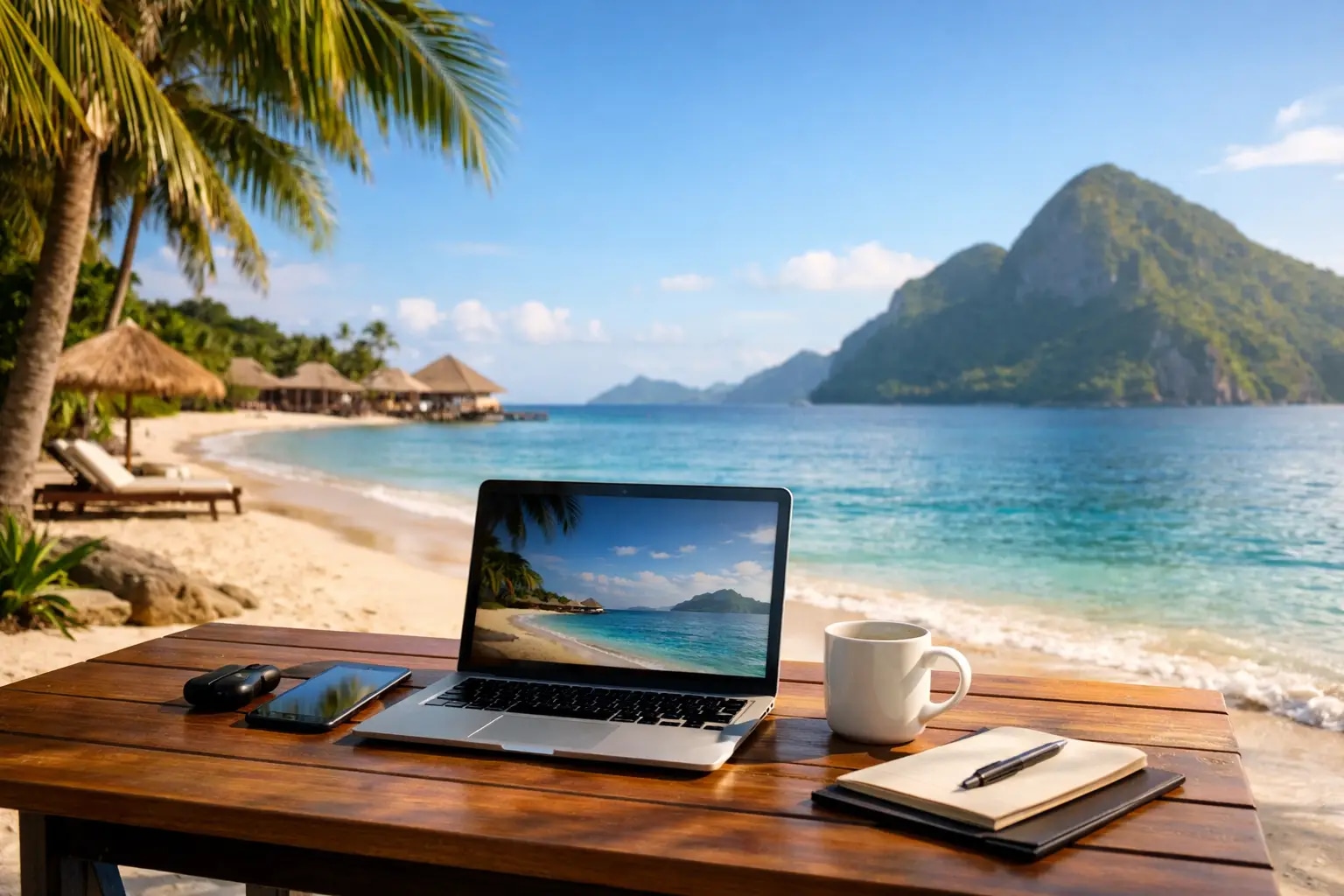
Some beach towns look perfect on Instagram and fall apart by Tuesday afternoon, right when your first video call freezes and the cafe owner starts stacking chairs for siesta. That is the real test with remote work beach destinations. Not just pretty water, but whether you can actually stay productive for two weeks, a month, or an entire season without spending half your day fixing logistics.
For travelers from the Balkans and diaspora communities in Germany, Austria, Switzerland, the US, and beyond, the calculation is usually practical before romantic. Can you get there without a complicated transfer? Is there stable internet in apartments, not just hotels? Can you walk to groceries, swim after work, and still keep costs under control? The best places balance all of that. They are not always the flashiest names on the coast.
What makes remote work beach destinations actually workable
A good remote-work base by the sea is usually built on boring things. Reliable apartments, mobile coverage, decent grocery stores, walkable neighborhoods, and enough year-round life that you do not feel stranded outside peak summer. Nice beaches matter, of course, but a destination becomes useful only when daily routine is easy.
There is also a trade-off between beauty and friction. Smaller places can be calmer and cheaper, but they may have fewer coworking options and weaker transport links. Bigger coastal cities are easier for longer stays, though they often come with traffic, higher prices, and more noise in July and August. It depends on how you work. If you need frequent calls and backup internet, choose infrastructure first. If your work is mostly asynchronous, you can afford to be more flexible.
10 remote work beach destinations worth considering
Split, Croatia
Split is one of the easiest starting points if you want the Adriatic without too much compromise. It has strong flight connections in season, a real city rhythm beyond pure tourism, and plenty of apartments where longer stays are realistic. You can work from your rental, rotate through cafes, and still reach the beach in minutes.
The downside is obvious. In peak summer, Split is expensive, crowded, and louder than many remote workers want. But in June or September, it becomes much more balanced. For diaspora travelers who want a coastal base with simple logistics, it is hard to dismiss.
Makarska, Croatia
Makarska works well for people who want a more vacation-like setting without giving up convenience. The seafront is lively, beaches are accessible, and you can settle into apartment living fairly easily. It feels more compact than Split, which many remote workers actually prefer.
The catch is that it is more seasonal. If you arrive outside the stronger months, the energy drops faster. That can be a benefit if you want peace, but less so if you like variety in your workday. It suits people who want structure, sea, and less city noise.
Budva, Montenegro
Budva is often treated as a party destination first, but that misses part of the picture. For remote workers, it offers a relatively practical setup - a wide accommodation range, walkable central areas, and a coast that lets you switch from laptop to swim with very little effort.
Still, Budva is not subtle in high season. Traffic builds up, prices climb, and the town can feel overstimulating if your workload is heavy. It works better for those who like active surroundings and can avoid the most crowded period.
Tivat, Montenegro
Tivat has become one of the more convenient Montenegrin bases for longer coastal stays. The airport proximity matters, especially if you are flying in from Western Europe and do not want to lose a day on transfers. The town is organized, polished, and easier to manage than some older coastal spots.
That polish comes at a price. Tivat is not the best choice if your priority is stretching every euro. But if you value convenience, cleaner urban layout, and quick airport access, it can be one of the smoother remote-work setups on the Adriatic.
Sarande, Albania
Sarande appeals to remote workers who want sea views and lower costs than much of Croatia or Montenegro. Apartments are often more affordable, eating out is still reasonable, and the town gives you easy access to beaches and southern Albanian coastline.
The main question is consistency. Some rentals are excellent, others are less dependable when it comes to internet quality or workspace comfort. If you choose Sarande, screening accommodation matters more than in a larger, more standardized market. Done right, it can be a very cost-effective base.
Himare, Albania
Himare is for people who care more about atmosphere than urban convenience. It is smaller, calmer, and more personal than Sarande, with beaches that feel less hurried. If your work allows a quieter pace, this can be one of the most pleasant places to spend a few focused weeks.
But it is not ideal for everyone. If you need coworking spaces, lots of backup options, or highly predictable transport, Himare may feel limiting. It is a better fit for self-contained remote workers who are happy with a laptop, a solid apartment, and a routine.
Chania, Crete
Chania gets a lot right. It has the beauty people expect from Greece, but also the practical side that longer stays require. There is enough city life, enough dining and shopping, and enough accommodation variety to support remote workers who are not just passing through for five days.
The old town is charming, but not always the smartest place to stay if you work regular US or European hours. Nearby residential areas are often quieter and more functional. Chania is not the cheapest option on this list, yet it offers one of the more complete balances between lifestyle and reliability.
Paralia Katerinis, Greece
Paralia Katerinis is rarely the first name people mention, which is exactly why it deserves attention. It is straightforward, accessible, and often easier on the budget than Greece's headline coastal destinations. For travelers from the Balkans, especially those arriving by car, it makes practical sense.
You will not get island glamour, and that is part of the appeal. It is a simple beach base where daily expenses can stay manageable and routine is easy to build. If you care more about function than bragging rights, it is a smart pick.
Burgas, Bulgaria
Burgas is one of the more underrated coastal cities for remote work. It has urban infrastructure, decent services, and Black Sea access without the same pricing pressure seen in more internationally hyped spots. For a longer stay, that matters more than postcard value.
It also works well for people who want a city first and beach second. If your work demands consistency, Burgas is often a safer bet than a smaller resort town. The trade-off is that it feels less romantic than parts of the Adriatic, but more grounded for real life.
Varna, Bulgaria
Varna is probably the strongest all-around Black Sea option for remote workers who want scale. There is more happening, more housing choice, more cafes, and generally more flexibility if your first apartment is not right. That extra depth reduces risk.
With that said, bigger city energy is not for everyone. If your idea of working by the sea means near silence and empty promenades, Varna may feel too busy. But if you want options and backup plans, it earns its place.
How to choose between these remote work beach destinations
Start with your work style, not your fantasy. If you are in calls all day, choose places with stronger infrastructure and easier airport access, such as Split, Tivat, Chania, Burgas, or Varna. If you work more independently and care about a slower rhythm, Makarska, Himare, or Paralia Katerinis may suit you better.
Budget changes the ranking too. Albania and parts of Bulgaria can offer better value for longer stays, especially if you book an apartment rather than rely on short-stay hotel pricing. Croatia and parts of Greece may deliver a smoother overall experience, but you usually pay for it in both rent and daily spending.
Season matters more than many people expect. A destination that feels ideal in late September can be frustrating in mid-August. Crowds affect internet, transport, noise, and apartment availability. For most remote workers, shoulder season is the sweet spot - warm enough to swim, stable enough to work, and less chaotic on the ground.
One more thing that often gets ignored is arrival friction. A place may be cheaper on paper, but if reaching it requires awkward transfers, a rental car, and half a day of waiting, the savings can disappear quickly. This is where regional travel knowledge matters. For many Balkan and diaspora travelers, the easiest route often shapes the best destination more than the beach itself.
If you are choosing a place for more than just a holiday, think like someone renting a temporary life, not buying a postcard. The right beach town is the one where your workday runs cleanly, your evenings feel easy, and staying an extra week sounds simple rather than complicated.
Ready for your next adventure?
Compare flights, accommodation and activities – ljetovanje.com helps you find the best deals for your perfect holiday.
ljetovanje.com
Travel expert and contributor for Ljetovanje.com