A ferry booking can look simple right up until you notice three ports with similar names, one catamaran that does not take cars, and a timetable that works perfectly in June but falls apart in September. That is usually the moment people start searching how to choose Adriatic ferry routes, especially if they are trying to fit island stops into a real vacation schedule rather than a postcard version of one.
The Adriatic rewards good planning. Distances on the map can feel short, but the right route depends on what kind of trip you are actually taking. A couple doing a week of island hopping will choose differently from a family driving from Austria to the coast, and differently again from someone in the diaspora trying to combine beach time with visiting relatives. The mistake is assuming the "best" ferry is the fastest one. Often it is the one that fits your base, your luggage, and your arrival day.
Start with the trip you want, not the ferry company
The easiest way to choose well is to work backward from your holiday plan. Ask yourself where you are sleeping most nights, whether you are bringing a car, and how much flexibility you really have. Those three things matter more than brand loyalty or small price differences.
If your plan is centered on one island, the route choice is mostly about access. You want the departure port that is easiest to reach from your airport, highway exit, or accommodation base. If your plan includes two or three islands, then schedule rhythm matters more. A route with one daily departure can be fine for a fixed stay, but it becomes risky if you are trying to connect the same day.
This is where many travelers overcomplicate things. They compare every possible crossing instead of narrowing the decision to one practical question: are you trying to get somewhere directly, or are you building the ferry ride into the experience? Those are two different trips.
How to choose Adriatic ferry routes by travel style
For families with kids, simpler is usually better. A direct car ferry from a mainland port to the island often beats a faster passenger-only option that still requires transfers, extra taxis, and hauling suitcases through old-town streets. Saving 40 minutes on the water is not much of a win if you lose two hours on each side.
For couples and lighter travelers, catamarans can make more sense. They are often quicker and can connect popular coastal towns and islands without the need for a car at all. But the trade-off is obvious - once you arrive, your mobility depends on local buses, transfers, walking distance, or paying more for transport on the island.
For diaspora travelers returning in peak summer, the route also has an emotional and practical layer. You may not be choosing the most scenic island connection. You may be choosing the one that best fits a late-night arrival, a family pickup, or a Saturday apartment check-in. That is not boring planning. That is realistic planning, and it usually leads to a smoother trip.
Pick the right departure port first
When people think about ferries, they focus on the destination island. In practice, the departure port is often the bigger decision.
A port that looks ideal on the map may be inconvenient if you are arriving by plane and need a transfer. Another might be perfect if you are driving from Germany, Slovenia, or inland Croatia because it fits your highway approach and avoids city traffic. A third may offer more daily departures, which gives you protection if your flight is delayed or the road journey takes longer than expected.
This is why route selection in the Adriatic is never just sea travel. It is road access, parking, airport timing, and check-in logistics. If you are bringing a car, also check how early you need to arrive at the port and how busy embarkation gets in high season. A route with an 8:00 a.m. departure may effectively require a 6:30 a.m. port arrival, which changes the entire previous night.
Car ferry or passenger catamaran?
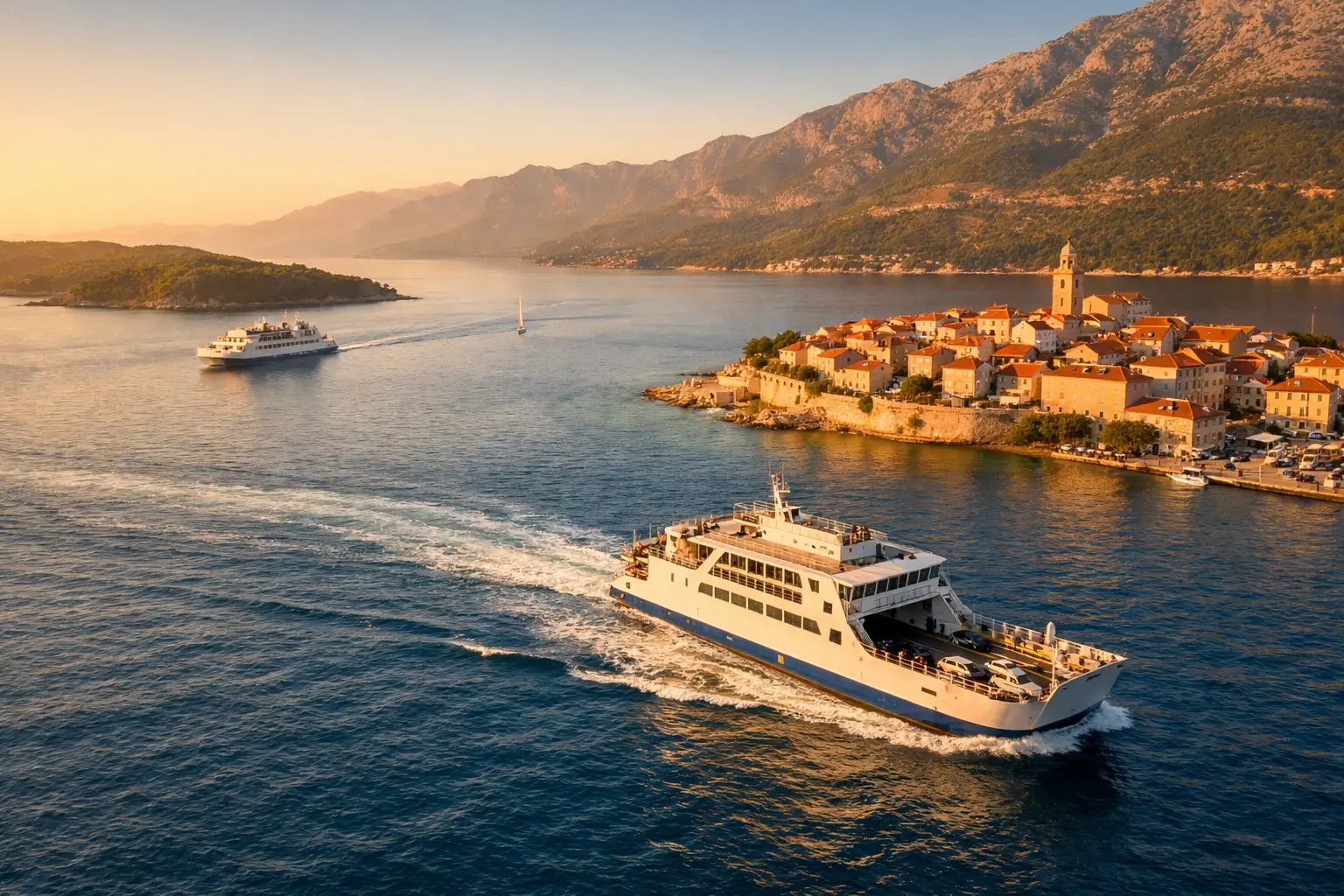
This choice shapes the rest of the trip. Car ferries are slower, but they give you flexibility once you arrive. That matters on larger islands, on trips with children, and in places where beaches, villages, and supermarkets are spread out.
Passenger catamarans are better when you want speed and light movement between places. They suit shorter stays, town-to-town travel, and travelers who want to avoid driving altogether. But they are less forgiving if you overpack or if your accommodation is far from the port.
If you are staying in one walkable town and do not plan to explore much, a catamaran can be the smarter choice. If you are booking a family apartment outside the center, the car ferry often saves hassle that does not show up in the ticket price.
Timing matters more than price
Everyone checks price first, but timetable fit usually matters more. A cheaper ticket is not really cheaper if it forces an extra hotel night, a long wait in the port, or an expensive transfer.
Look closely at departure frequency. Some Adriatic routes run many times a day in summer and much less often outside peak season. Others have strong weekend demand patterns because so many trips follow Saturday-to-Saturday accommodation schedules. If your trip is built around fixed check-in days, your ferry choice should support that, not fight it.
Weather is the other timing issue people underestimate. Fast passenger services can be more sensitive to rough conditions than larger ferries. That does not mean you should avoid them, only that you should think about your margin for error. If missing one sailing means missing your apartment handover or rental pickup, choose a route with backup options.
How to compare Adriatic ferry routes without getting lost
The practical way to compare routes is to filter by four things: total travel time, number of transfers, car eligibility, and arrival practicality. Not advertised crossing time - total travel time. A 50-minute sailing is less attractive if it requires a two-hour detour to reach the departure port.
Then look at what happens when you arrive. Is the port close to your accommodation area? Will you need another bus or taxi? Are you landing in a town where walking is realistic with luggage, or are there hills, stairs, and a long waterfront in the sun? In the Adriatic, the last mile often decides whether a route feels easy or exhausting.
This is also where shoulder season changes the answer. In July and August, the route with more departures may justify a slightly higher price because flexibility is valuable. In May, June, or September, a quieter direct route may be the better deal because ports are less chaotic and transfer pressure is lower.
Match the route to the island itself
Not all islands work the same way. Some are compact and easy without a car. Others are beautiful but spread out, with beaches and villages that make much more sense if you can drive.
If the island has one main town and your accommodation is nearby, a passenger route is often enough. If the island is larger or your apartment is in a smaller settlement, the ferry that carries your car can be worth both the longer crossing and the higher fare.
Also think about purpose. If your priority is old-town atmosphere, restaurants, and evenings on foot, arriving as a foot passenger can feel right. If your priority is swimming in different coves, carrying kids' gear, or combining beach days with family visits, having your own vehicle changes everything.
Avoid the common booking mistakes
The most common mistake is booking too tightly around flight arrivals. A delayed plane can turn a neat connection into a stressful scramble. If you are arriving from the US or Western Europe with multiple legs, leave more buffer than you think you need.
The second mistake is assuming all ferries carry vehicles. They do not. Many travelers only notice this after choosing the fastest service. The third is ignoring return timing. An outbound route can look ideal until you realize the return forces a very early departure or does not line up with your next stop.
One more thing: in peak summer, the best route is sometimes simply the one you can still realistically book at the times you need. Popular crossings fill up, especially for vehicles. Planning early gives you better choices, not just lower stress.
A smart rule for deciding faster
If you are stuck between two or three route options, choose the one that removes the most friction from the rest of the trip. That usually means fewer transfers, easier port access, and a better fit with your accommodation and arrival day. The Adriatic is full of beautiful crossings, but the route you remember fondly is usually the one that let the vacation start smoothly.
That is the useful answer to how to choose Adriatic ferry routes. Not by chasing the shortest line on the map, but by picking the crossing that fits how you actually travel. If the route works with your real schedule, your luggage, your family, and your plans on arrival, you have probably chosen well. And once that part is settled, the sea starts feeling like the easy part.
Ready for your next adventure?
Compare flights, accommodation and activities – ljetovanje.com helps you find the best deals for your perfect holiday.
ljetovanje.com
Travel expert and contributor for Ljetovanje.com