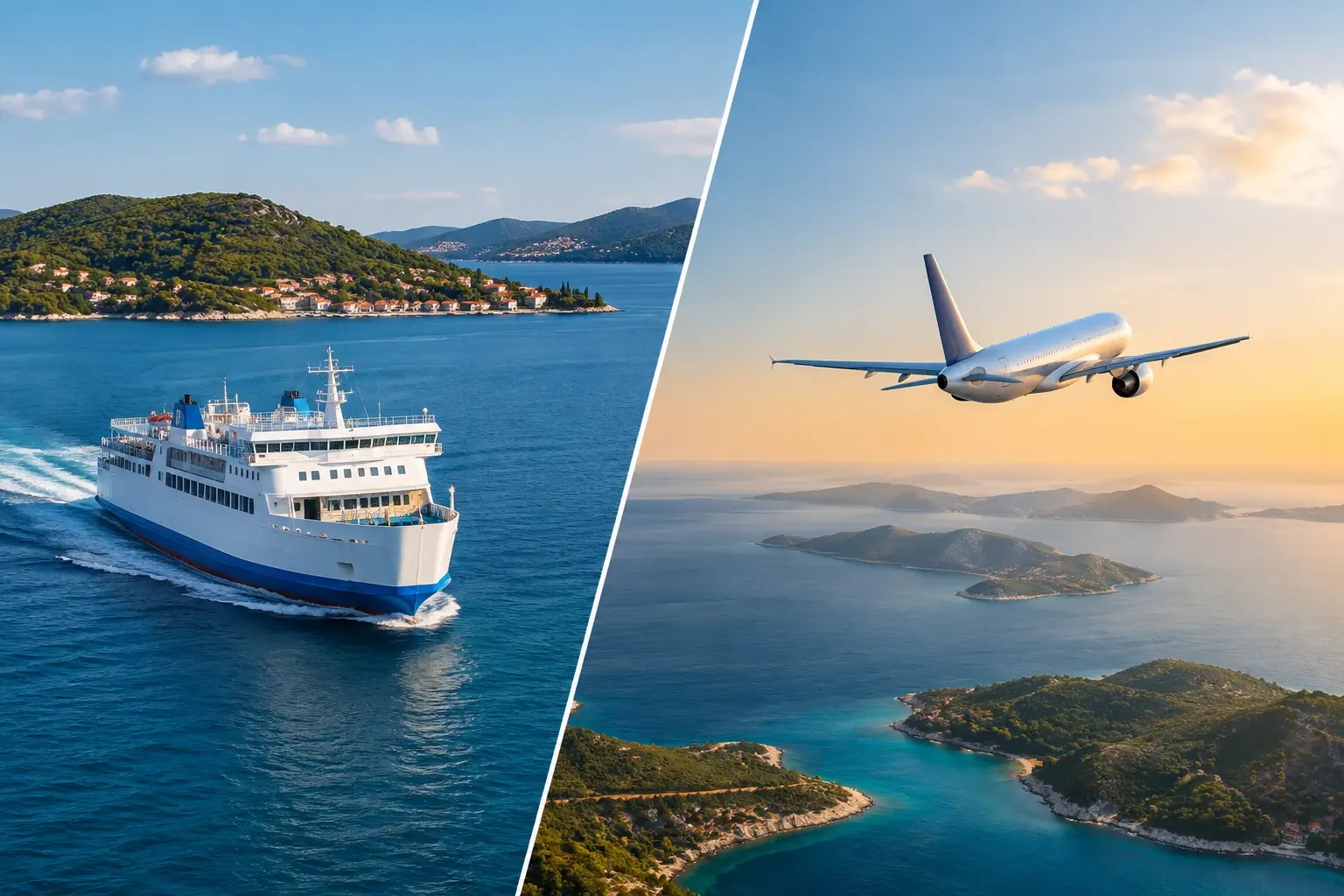
A 7:10 a.m. flight can look like the obvious choice until you add airport parking, checked-bag lines, a transfer to the port, and the final boat ride. On the other hand, a ferry that looks cheap on a booking screen can quietly take most of a holiday day. For travelers weighing ferry or flight islands options, the best answer is rarely about the ticket price alone. It is about where you start, who is traveling with you, and whether the journey itself should be part of the vacation.
For diaspora travelers coming from the U.S., Germany, Switzerland, or Austria, the decision often starts after landing on the coast. For families driving from Serbia, Bosnia and Herzegovina, or inland Croatia, it may be about whether taking the car changes the entire trip. The practical choice is the one that leaves you with more usable time and less unnecessary coordination.
Ferry or Flight Islands: Start With the Real Door-to-Door Time
A flight time is not travel time. This matters most on islands with smaller airports, limited schedules, or indirect connections. A 45-minute domestic flight can easily become a four-hour process once you factor in arriving early, collecting luggage, waiting for a rental car, and getting from the airport to your accommodation.
Ferries work the same way. Do not compare only sailing duration. Check how far the departure port is from your airport or home, how early you need to arrive with a vehicle, and whether your accommodation is near the arrival port. A two-hour sailing from Split to an island can be easier than a short flight if your apartment is a 10-minute walk from the ferry terminal.
The key question is simple: when will you actually be checking in? For a three- or four-night break, that answer should carry more weight than the headline journey time. Losing half a day at both ends is a poor trade for a modest saving.
When flying makes practical sense
Flying is usually the better call when the island has a well-connected airport and you are traveling light. It is particularly useful for short stays, couples who do not need a car, or travelers arriving on an international connection that lines up well with a domestic flight.
Greek islands are the clearest example. If you can fly directly to an island or make a sensible same-day connection, flying can save substantial time compared with traveling via Athens and then waiting for a ferry. It also reduces the risk of a long port layover after an overnight flight.
The same logic applies to a few larger Adriatic islands where seasonal air service is available. But check the timetable closely. A flight that operates only twice a week is not flexible, and a late landing can turn a straightforward plan into an overnight stay on the mainland.
When the ferry is the smarter route
A ferry is often the better choice when you are taking a car, packing for children, or planning to explore beyond one town. On Croatian islands, a vehicle can be less of a luxury and more of a practical tool, especially if your accommodation is outside the main port settlement or you want to reach quieter beaches without relying on limited local buses.
Ferries also make sense when the crossing is direct and frequent. Routes from coastal hubs such as Split, Zadar, or Dubrovnik can be more predictable than trying to build an itinerary around a small airport. If you are already spending a night on the mainland, a morning catamaran may be the calmest start to an island stay.
There is another benefit people underestimate: luggage. Families can bring a stroller, beach gear, groceries for the first day, and more than one small bag without turning every transfer into a negotiation. That freedom has value, especially for a one- or two-week apartment stay.
Cost Is More Than the Base Fare
Low-cost flight pricing can be attractive, but compare the complete trip. Add seat selection if you need to sit together, checked luggage, airport transfers, parking, and the cost of reaching the airport in the first place. For a couple with only backpacks, the flight may remain clearly cheaper. For a family of four with two suitcases and a car rental at the destination, it may not.
Ferry prices also need context. A passenger ticket can be inexpensive, while a car crossing during peak summer dates may change the total quickly. Reservations for popular vehicle routes are especially important in July and August, when arriving without a booking can mean waiting for a later departure.
Think about transport once you arrive. Flying can look economical until you need a rental car for seven days. Taking your own vehicle on the ferry may cost more upfront but avoid rental rates, child-seat fees, and the inconvenience of collecting and returning a car. Conversely, if you are staying in a walkable old town, paying to bring a car that mostly sits parked is wasted money.
Match the Route to Your Type of Vacation
Not every island vacation needs the same transport plan. A car-free couple’s week in a harbor town has different requirements from a multigenerational family stay in a house above a remote bay.
For a relaxed, apartment-based holiday, ferries usually have the advantage. You can bring what makes the stay easier, shop on the mainland if needed, and move at your own pace. This is especially useful for travelers who return to the Adriatic every summer and prefer familiar routines over tightly timed connections.
For a quick escape focused on one resort, beach, or town, flying can be better. Pack light, book an airport transfer, and avoid the expense and responsibility of a vehicle. The approach works well when the island has dependable taxi service, local buses, or accommodation within walking distance of restaurants and the sea.
Island hopping changes the calculation again. Ferries are often the natural option because they connect places flights do not. In Greece, a route between neighboring islands can be far more sensible by sea than returning to the mainland to fly. Still, avoid building a schedule with no margin. One delayed sailing can affect every booking that follows.
Weather, Schedules, and the Risk You Can Actually Manage
Summer travelers often plan as if every route will run exactly as advertised. Most of the time, it will. But wind, rough seas, late arrivals, and seasonal schedule changes can disrupt both ferries and flights.
Ferries are more exposed to sea conditions, particularly fast catamarans on open-water routes. If you are prone to motion sickness, choose a larger conventional ferry when possible, sit near the center of the vessel, and keep the crossing day flexible. A ferry may be scenic in calm weather, but that is not a useful benefit if everyone arrives exhausted.
Flights are vulnerable in a different way. A missed connection can be difficult to recover from when the next island service is tomorrow or several days later. If an international arrival and domestic flight are on separate bookings, allow generous time between them. The same rule applies to flights that must connect with a final ferry.
For either route, avoid booking a nonrefundable accommodation arrival on the last possible connection if you have no fallback plan. A first night near the departure port is not always necessary, but it can be a smart buffer after a long-haul journey.
A Better Way to Decide Before You Book
Compare two complete itineraries, not two individual tickets. Write down departure from home, arrival at the airport or port, waiting time, transfers, luggage costs, and the final distance to your accommodation. Then calculate the return trip too. A route that feels easy on arrival may be painful for a 6:00 a.m. departure.
Also ask what you will need during the stay. If the answer includes a rental car, child seats, frequent beach trips, or visits to villages away from the main town, price the ferry option with your own car. If the answer is a central hotel, hand luggage, and a short stay, price the flight with transfers instead.
Ljetovanje.com travelers often know the difference between a good deal and a workable holiday: the cheapest route is not always the one worth taking. A few extra dollars can buy an earlier arrival, fewer transfers, and a first evening that begins with dinner by the water instead of waiting beside a baggage belt.
Choose the ferry when it gives you freedom on the island and fits naturally into your drive. Choose the flight when it genuinely removes hours of travel, not when it merely makes the itinerary look shorter. The goal is simple: arrive with enough energy to enjoy the place you came for.
Ready for your next adventure?
Compare flights, accommodation and activities – ljetovanje.com helps you find the best deals for your perfect holiday.
ljetovanje.com
Travel expert and contributor for Ljetovanje.com