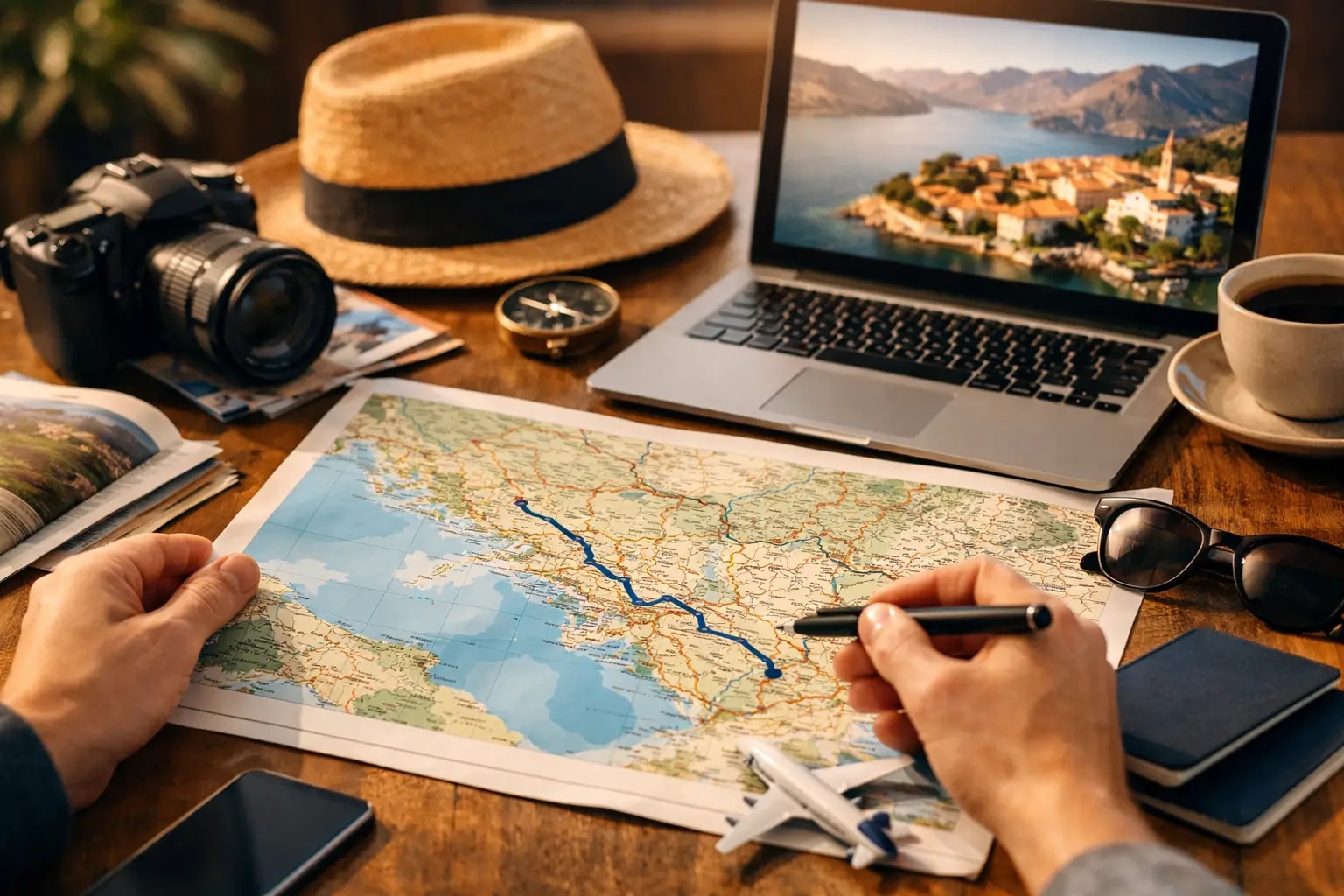
A Balkan trip can go wrong before you even book anything. Not because the region is difficult, but because people try to do too much - six countries in nine days, backtracking between airports, or squeezing coast, mountains, and cities into one rushed loop. If you're figuring out how to plan a Balkan trip, the smartest move is usually to make it smaller, not bigger.
The Balkans reward travelers who plan around distance, season, and purpose. That matters even more if you're coming from the US, or from the diaspora in Germany, Austria, or Switzerland, where flight convenience often shapes the whole trip. A good itinerary here is not about checking off flags on a map. It's about building a route that feels realistic once airport transfers, border crossings, beach days, and family expectations enter the picture.
How to plan a Balkan trip starts with one base idea
Before you compare flights or save apartments, decide what kind of trip this actually is. That sounds obvious, but it changes everything. A summer coast trip through Croatia and Montenegro needs a different rhythm than a food-and-city route through inland capitals. A family holiday with a car has different priorities than a couple's trip built around short stays and low-cost flights.
Start with one anchor. That could be the Adriatic coast, a wedding or family visit, a road trip, or one country you've wanted to know properly instead of just passing through. Once you have that anchor, the rest becomes easier to filter. Places stop looking equally necessary.
This is also where many travelers save money without trying too hard. If your real goal is seven quiet days by the sea, you do not need to add a capital city just because it looks efficient on a map. If your trip is half vacation and half visiting relatives, treat those as two different blocks instead of forcing them into one seamless itinerary that never really works.
Pick a route, not a wishlist
The biggest planning mistake in the Balkans is underestimating travel time. Distances can look short, but roads, mountain terrain, ferry schedules, summer traffic, and border queues can stretch the day quickly. Three hours on paper can become five in practice.
A better approach is to build around one logical corridor. For example, if you're flying into Split and want a coast-focused trip, keep moving south along the Adriatic instead of zigzagging inland and back. If you're landing in Tirana, it makes more sense to shape the trip around Albania's coast or nearby inland stops than to bolt on distant detours just for variety.
Open-jaw flights can help if your route is linear - arriving in one city and leaving from another. But they are only worth it when the fare difference is reasonable and the route truly saves time. Sometimes a round-trip flight plus one well-placed bus or car rental is simpler.
If you have one week, one country or one compact region is enough. With ten to fourteen days, two countries can work well if the crossing is natural and you are not changing beds every night. More than that starts feeling ambitious unless travel itself is the point.
Good Balkan itineraries leave room
The best routes in this region usually have fewer stops than people expect. Two or three bases often beat five one-night stays. You spend less time packing, less money on transit, and more time actually being where you came to be.
This matters even more in summer. Coastal travel looks easy online until Saturday turnover traffic, late check-ins, and hot afternoon drives start eating the day.
Choose the season before you choose the destination
If you plan the Balkans without thinking about timing, you can end up paying peak prices for a trip that doesn't suit you. July and August are great if you want heat, beach energy, and a full summer atmosphere. They are less great if you want quiet roads, flexible lodging, or last-minute freedom.
June and September are often the sweet spot. The sea is warm enough in many coastal areas, prices can be more reasonable, and the pace is easier. For travelers with school-aged kids, this may not always be possible, but for couples and remote workers it is often the difference between a pleasant trip and a crowded one.
If your focus is cities, food, or nature rather than swimming, shoulder season is usually the better choice. Inland destinations can be far more enjoyable in spring or early fall than in the peak heat of midsummer.
Summer coast or mixed trip?
This choice affects your packing, budget, and transport. A coast-only trip is simpler and usually better for a shorter vacation. A mixed trip with beaches, mountain towns, and city stops gives more variety, but only if you accept longer travel days and more planning.
There is no prize for forcing everything into one visit. The Balkans are better experienced in chapters.
Flights, cars, and transfers matter more here than people think
Many travelers plan the destination first and the logistics second. In the Balkans, that order often creates friction. The better move is to check airport options early, then build the trip around the smoothest arrival.
Direct flights are not always available from the US, so your connection city can shape the best route. If you're in the diaspora, the usual corridors from German-speaking Europe often offer better timing into coastal airports during summer. That can make one destination far more practical than another, even if both looked equal at the start.
Car rentals are useful when you're combining smaller towns, beaches, or inland areas where schedules are thinner. They are less useful in old coastal centers where parking is expensive, limited, or simply annoying. If your trip is mostly one city and one beach town with good transfers, you may not need a car every day.
Buses are common and can be perfectly workable for direct links, but they are not ideal if you are carrying a lot of luggage, traveling with kids, or crossing multiple stops in one day. Ferries can also be part of the plan, especially on the coast, but only if you treat their schedules as fixed constraints rather than flexible suggestions.
Border crossings and documents are part of the plan
Anyone learning how to plan a Balkan trip should think about borders early, not two days before departure. Requirements depend on your passport, residency, and route. Even where entry is straightforward, crossing times can vary sharply in peak season.
If you are driving, check what your rental agreement allows across borders. If you are using buses or private transfers, leave margin in the schedule. Tight same-day connections can look efficient right up until they are not.
This is especially relevant for travelers visiting family while also planning a holiday. A route that seems easy in theory can become tiring if every second day includes a crossing, a transfer, and a late check-in.
Stay where your days make sense
Accommodation in the Balkans is not just about star ratings. Location matters more. A well-run apartment near the beach, ferry port, or old town can improve the trip more than a nicer place that adds daily driving and parking stress.
For many travelers from the region and diaspora families, apartments still make the most sense. You get more space, easier routines, and better value for longer stays. Hotels can work well for short city stays or one-night transitions, but for a week on the coast, a practical apartment often fits real travel behavior better.
Use your itinerary to decide the stay, not the other way around. If you plan to spend most days swimming, do not book inland to save a small amount and then lose time commuting. If your priority is a walkable old town, make sure your place is actually walkable and not just "nearby" on a map.
For comparison across routes, stays, and transport options, Ljetovanje.com can help reduce the usual tab chaos that comes with planning this kind of trip.
Budget for movement, not just nights
People often budget the flight and accommodation, then underestimate what the moving parts cost. On a Balkan trip, expenses build through airport transfers, tolls, parking, ferries, extra border insurance, and meals on travel days.
The fix is simple. Build your budget in blocks: arrival and departure, local transport, accommodation, and daily spending. Then ask where convenience is worth paying for. Sometimes a slightly pricier stay in the right location saves enough in parking, fuel, or transfers to make it the better deal.
The same goes for trip length. A shorter, better-paced trip is often cheaper than a longer one filled with inefficient movement. More days do not always mean more value.
Leave space for the part you can't schedule
Some of the best moments in the Balkans are the least engineered ones - the beach you stop at because the water looks better than expected, the extra coffee in a harbor town, the family lunch that runs long, the roadside bakery you end up talking about for the next week.
Good planning makes room for that. It gets the flights, route, documents, and lodging right so the trip does not feel like constant correction. If you plan well, the Balkans stop feeling complicated and start feeling exactly as they should - close, familiar, and full of places worth staying a little longer than you planned.
Ready for your next adventure?
Compare flights, accommodation and activities – ljetovanje.com helps you find the best deals for your perfect holiday.
ljetovanje.com
Travel expert and contributor for Ljetovanje.com